Product Description
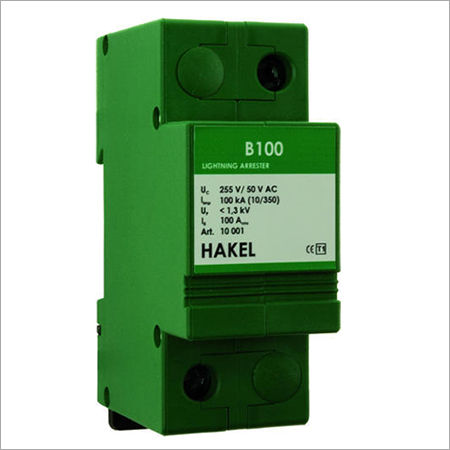
Spark Gap Lightning Arrester, HS100i is a type 1 and class I lightning current arrester in accordance to EN 61643-11 and IEC 61643-1. It is widely used in Lightning Protection Zones Concept at the LPZ 0 to 2 boundaries (as per the IEC 1312-1 and EN 62305) in order to bond lightning current equipotential in power supply systems that enter the building structure. It can bond lightning protection equipotential to VDE 0185-305 (IEC 62305)
An encapsulated spark gap technology is followed in the construction of Spark Gap Lightning Arrester to be installed in main switchboards. It is used with lightning current arrester HS50-50i mainly used for equipotential bonding between N and PE, for TNS and TT systems. HS100i finds its main use in industrial installations, like transformers, the main switchboards of large industrial buildings and areas at high risk of a direct lightning strike and with an outdoor lightning protection of the highest class I to IV. It is also ideal to be used in unmeasured parts of electrical installation.
Lightning Current Arresters - Spark Gap
HS100i >> Encapsulated spark gap lightning current arrester type 1 >> 1 - pole arrester >> AC power supply network TN-S, TT >> LPZ 0 - 2 >> LPL I to IV >> I imp 100 kA
Specification
| Brand | Hakel |
| Arrester Type | Intermediate Type, Station Type, Distribution Type |
| IP Rating | IP 20 |
| Model | B 100 |
Superior Overvoltage ProtectionThis lightning arrester effectively protects electrical installations from transient overvoltages caused by lightning strikes or switching surges. Its high protection level and fast response time swiftly divert excessive electrical currents away from sensitive equipment, reducing damage risk and ensuring system longevity.
High Durability and Minimal MaintenanceCrafted from corrosion-resistant porcelain and copper, the device offers excellent durability in challenging outdoor and polluted environments. Its glazed surface finish, IP65 rating, and minimal maintenance requirements make it a suitable choice for long-term outdoor installations across India.
Easy Installation and Versatile MountingThe cylindrical, single-pole arrester features standard terminal and screw connections, supporting both vertical and wall mounting. With a compact size and lightweight design (approx. 2 kg), installation is straightforward, allowing quick deployment into new or existing electrical systems.
FAQs of Spark Gap Lightning Arrester:
Q: How does this spark gap lightning arrester protect against overvoltage events?
A: It operates by creating a controlled air gap between electrodes, which ionizes and discharges overvoltages (up to 10 kA) safely to ground. This rapid response (<1 microsecond) ensures that electrical equipment downstream remains unharmed by sudden voltage spikes caused by lightning or switching surges.
Q: What makes the arrester suitable for outdoor and polluted environments?
A: The arrester features a corrosion-resistant porcelain/copper build, a glazed surface finish, and is rated IP65, providing strong resistance against humidity (up to 95% RH), dust, and pollutants. These properties enable reliable long-term operations in harsh environmental conditions.
Q: When should this lightning arrester be installed in an electrical system?
A: Installation is recommended during system upgrades, new installations, or in areas especially prone to thunderstorms and overvoltage riskssuch as substations, distribution panels, and outdoor electrical networks operating at 11 kV AC.
Q: Where is the optimal mounting location for this device?
A: The arrester is designed for outdoor placement in vertical or wall-mounted positions near entry points of power lines, ensuring direct protection to electrical infrastructure exposed to surges. Its compact size allows flexibility in constrained spaces.
Q: What is the typical process for maintaining this arrester?
A: Owing to its minimal maintenance design, routine visual inspections for physical damage or contamination are usually sufficient. Cleaning the glazed porcelain exterior periodically will help maintain optimal performance over its service life, which exceeds 10 years.
Q: How does the product benefit power system operators?
A: Operators gain improved system reliability, reduced equipment downtime, and extended infrastructure lifespan through rapid overvoltage protection. With its low energy consumption and high efficiency (98%), operational costs remain low while safety is maximized.
 Send Inquiry






 English
 Spanish
 French
 German
 Italian
 Chinese (Simplified)
 Japanese
 Korean
 Arabic
 Portuguese


 Send Inquiry