Product Description
In normal weather conditions, positive and negative charges maintain balance, the ground can be more negatively charged than the air, and the elements are placed on the ground. A charge polarization is created as the storm clouds form. The negative charge is more on the lower part of the cloud that induces a positive charge at the ground and other elements on it. The electric field at the atmosphere can reach 10s of kilovolts. The positive charge induced is more evident at pointed objects, trees and metallic objects. The cloud discharges the electric field towards the ground, if it is high enough. Downward leader is the path formed by the electric discharge. It produces sharp electric field variations, which cause corona effect. It is a point when an object that can form an upward leader is required. It will form a straight discharge path from cloud to the ground. It will receive the lightning strike and discharge it. It can control several damages.
Following are the different effects of lightning:- Electrical effects: Equipment destruction. Equipment connected to electrical network can be damaged by rises and surges in ground voltage.
- Electrodynamical effects: Structural damages. Deformations and rupture can be caused when conductors submitted to mechanical strengths are placed inside a magnetic field originated in another conductor.
- Thermal effects: Fires. Fire can be caused by heat dissipation by Joule effect.
- Effects on living beings: Burns and electrocutions. Even during a short lapse, current passed is enough to electrocute and burn.
- Induction effects: As the electromagnetic field is variable, induced currents appear in every conductor. Damages can be severe if these conductors are connected to electronic equipment.
Lightning strike and fires due to electric discharge can cause severe damages in buildings and equipment, thus drive economical losses. Service interruptions, halt in production processes and damaged control equipment due to lightning can incur high costs.
Product Details:- Lightning impulse current (10/350): 50 KA Iimp
- Nominal discharge current (8/20): 50 KA In
- Response time Ta: Less than 100ns
- Follow current interrupting rating at Uc 25 KA Ifi Max. back-up fuse 500 AgL/gG
Specification
| Follow current interrupting rating at Uc | 25 KA Ifi |
| Lightning impulse current (10/350) | 50 KA Iimp |
| Max. back-up fuse | 500 AgL/gG |
| Nominal discharge current (8/20) | 50 KA In |
| Response time Ta | Less than 100ns |
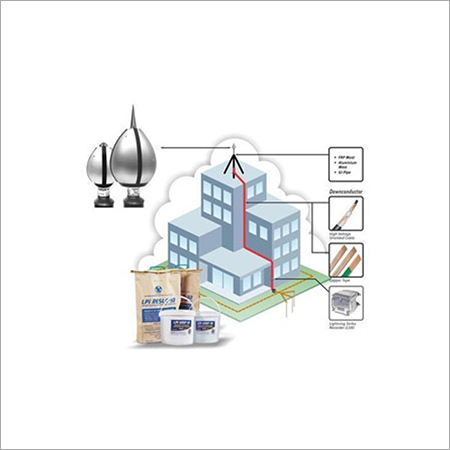
Our system provides dependable external lightning protection for diverse buildings, employing high-conductivity materials and rugged construction for durability. It can be tailored to architectural demands, protecting rooftops, perimeters, and tall towers. The system is engineered for outdoor environments, ensuring corrosion resistance and consistent performance.
Comprehensive System Components IncludedEach installation includes essential parts: an air terminal rod, base plate, bonding clamps, robust conductors, and secure connectors. This ensures a complete lightning protection network, ready for deployment with customizable lengths, diameters, materials, and finishes to meet project specifications.
Low-Maintenance and Long-Term SolutionDesigned for longevity, the system operates effectively with minimal upkeep. Periodic inspections are recommended for ongoing reliability. Its resistance to corrosion and environmental stress means users benefit from over two decades of steadfast protection in standard conditions.
FAQs of External Lightning Protection System:
Q: How does the external lightning protection system work?
A: The system works by directing lightning strikes safely to the ground using air terminal rods positioned at critical locations. These rods transfer the electrical energy through highly conductive copper or galvanized iron conductors to the earth via direct earthing, minimizing the risk of structural damage.
Q: What is included in the lightning protection system package?
A: The package contains essential components such as air terminal rods, base plates, bonding clamps, conductors, and heavy-duty clamps and connectors, ensuring a complete setup for reliable lightning diversion and grounding.
Q: When should periodic maintenance or inspection be performed?
A: Inspections are recommended periodically, typically once a year or after severe weather events. This ensures all connections remain secure and components are free from corrosion or mechanical damage, maintaining the systems effectiveness.
Q: Where can this system be installed?
A: The system is designed for outdoor installation on main roofs, building perimeters, and towers, making it ideal for commercial, industrial, and residential structures throughout varied locations in India.
Q: What are the customizable options available for this product?
A: Clients can customize the systems length (1 to 3 meters), diameter (12 mm 25 mm), material (high conductivity copper or galvanized iron), surface finish (polished or hot dip galvanized), and pole type to suit specific site or project needs.
Q: How does the system benefit building owners and operators?
A: It offers reassurance and asset protection by reducing risks of fire, electrical surges, and structural damage caused by lightning. The durable, corrosion-resistant design ensures long-lasting security with low ongoing maintenance costs.
 Send Inquiry






 English
 Spanish
 French
 German
 Italian
 Chinese (Simplified)
 Japanese
 Korean
 Arabic
 Portuguese


 Send Inquiry